
Writing Prompts Generator
Stuck for an idea? Generate writing prompts for stories, journals, essays and poems. Choose a genre and audience, add an optional constraint such as a word limit or a required object, and keep generating until something sparks. Print or copy your favourites.
- Free to use
- No sign-up
- Runs in your browser

Generate writing prompts
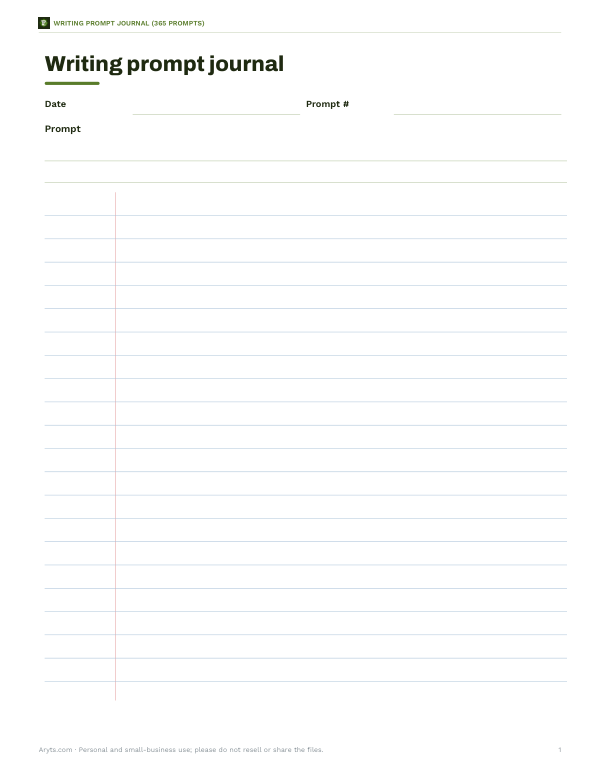
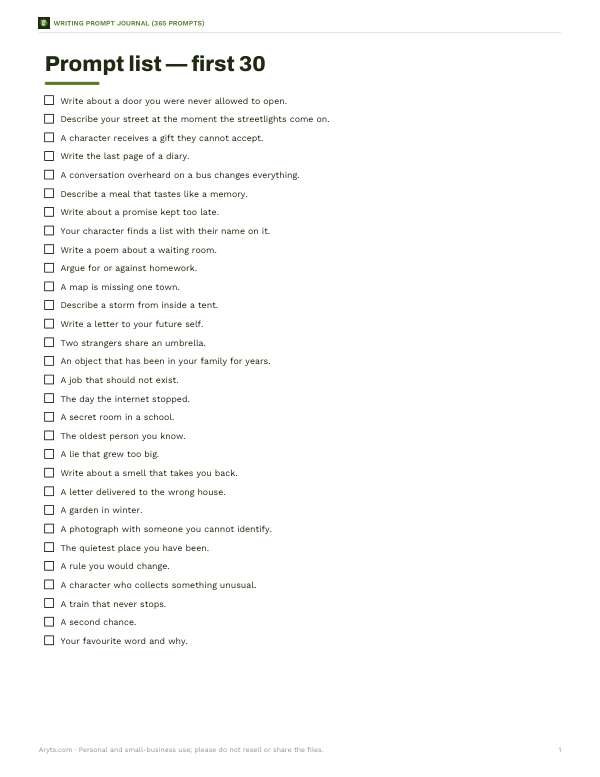
Writing Prompt Journal (365 Prompts)
A printable 365-day prompt journal with story, journal, poetry and essay prompts, writing pages and a streak tracker.
- Prompt journal pages (PDF, DOCX)
- 365 prompts list (PDF, DOCX)
- Streak tracker (PDF, XLSX)
Formats: PDF, DOCX, XLSX. Instant download after payment (link valid 72 hours, up to 5 downloads). AI-assisted: the templates were drafted with AI help and reviewed and laid out before publishing.
$5.00 USD, one-time 3 files · about $1.67 each
- Instant download
- 7-day refund
- Secure checkout by Stripe
7-day money-back guarantee. Full refund within 7 days of purchase, even after you download.
Full refund within 7 days — see the refund policy and license.
Free printables
Single sheets you can print right now, no sign-up. The full pack adds every sheet in one download plus the editable files.
How the generator builds prompts
Story prompts combine three ingredients — a character, a setting and a problem — drawn at random from lists written to be specific and a little unusual: a courier who never reads the packages, on a ferry crossing in fog, who finds a letter addressed to them dated fifty years in the future. That mix of the ordinary and the strange is what makes a prompt useful: it gives you a situation with built-in questions. Journal, essay, poetry and children's prompts are complete prompts chosen from curated lists. Constraints — a word limit, an object to include, a first line or a point of view — add a creative challenge.
Types of prompts
| Type | Best for | Example |
|---|---|---|
| Story | Fiction practice, NaNoWriMo warm-ups, flash fiction | A detective afraid of the dark, during a city-wide blackout, who hears a knock from inside the wall |
| Journal | Reflection, wellbeing, habit building | Write about a time you changed your mind. |
| Essay | Argument practice, debate, test preparation | Should the school day start later for teenagers? |
| Poetry | Imagery, form and voice | Write about a colour without naming it. |
| Kids | Classroom writing time, ages 7–11 | Your shadow runs away. Where does it go? |
How to use a prompt
- Generate a few prompts and pick the one that makes you ask a question.
- Set a timer — 10 to 20 minutes — and write without stopping to edit.
- If you get stuck, ask the prompt a question: why this person, why now, what do they want, what stands in the way?
- Stop when the timer ends, then read back and underline the best sentence.
- Keep your favourite pieces; many finished stories start as ten-minute drafts.
Why constraints help creativity
It sounds backwards, but limits often make writing easier. A blank page offers infinite choices; a 250-word limit, a required object or a fixed first line narrows the options and gives your mind a puzzle to solve. Poets have used fixed forms like sonnets and haiku for centuries for the same reason. Try the same prompt twice with different constraints and compare the results.
Prompts for teachers
- Project one prompt at the start of class as a five-minute warm-up.
- Let students choose from three prompts to increase ownership.
- Use essay prompts to practise claim, evidence and reasoning, or to prepare for debates.
- Use the kids setting for younger classes and the point-of-view constraint to teach perspective.
- Print prompt lists for writing centres and early finishers.
- Ask students to write their own prompts using the character–setting–problem formula.
Worked example
The generator suggests: “Write a story about a gardener who grows impossible plants, in a library that closes at midnight, who inherits a key with no lock. Include a cracked teacup.” Questions tumble out immediately: why is a gardener in a library at night? What impossible plant grows there? What might the key open — perhaps the teacup is the lock? Ten minutes of writing gives you an opening scene; the constraint gives you a detail to build a twist around.
Building a writing habit
Short daily practice builds skill faster than occasional long sessions. Pick a regular time, write for ten minutes to a prompt, and do not judge the result. Track your streak on a calendar. After a month you will have thirty pieces of raw material — more than enough to find a story worth developing. If you write with friends, share prompts and compare how differently each of you interprets the same starting point.
Prompts by goal
| If you want to… | Try this | Why it helps |
|---|---|---|
| Warm up before a longer project | A 10-minute story prompt with a word limit | Short, low-stakes writing loosens up your style |
| Understand yourself better | Journal prompts, three times a week | Regular reflection builds self-awareness |
| Prepare for an exam essay | Essay prompts with a 30-minute timer | Practises planning and arguing under time pressure |
| Improve imagery | Poetry prompts about the senses | Poems reward precise, concrete detail |
| Get reluctant young writers started | Kids prompts, read aloud and discussed first | Talking first lowers the barrier to writing |
Revising a prompt draft into a finished piece
A prompt draft is raw material. To turn one into a finished story, poem or essay, let it rest for a day, then read it aloud and mark the moments with energy — a striking image, a surprising line of dialogue, a question you want answered. Cut everything that only explains what the prompt said. Decide what the piece is really about, which may be different from the prompt, and rebuild around that. Many writers keep only a few sentences from the first draft, and that is normal: the prompt did its job by getting words on the page.
Frequently asked questions
Are the prompts random?
Yes. Story prompts combine random characters, settings and problems; other types are drawn from curated lists.
Can I use these prompts in my classroom?
Yes, generate and print as many as you like for teaching.
Who owns what I write from a prompt?
You do. A short prompt is a starting idea; your writing is your own work.
What is a good length for a prompt response?
Anything from a 100-word flash piece to a full short story. Timed 10–20 minute sessions work well.
Are the kids prompts age-appropriate?
They are written for ages 7–11 and avoid frightening or mature themes.
Can I save prompts?
Copy or print them; the page does not store history.
How many prompts are there?
Story prompts combine dozens of characters, settings and problems into thousands of possible combinations; the other types draw from curated lists that are expanded over time.